
The best photo spots in San Francisco, and how to beat the fog
Golden Gate views from both ends, the Lands End labyrinth, the Painted Ladies and the skyline from Treasure Island, with the months the fog is most likely to spoil them.
San Francisco's best photo spots come with a weather warning. From June to August, cold ocean water and hot inland valleys pull a bank of fog through the Golden Gate most afternoons, and it can sit on the bridge for days. Some of the city's best photos are taken in it. Many more are ruined by it. Which one you get depends mostly on how high you're standing.
We can see it in the numbers. For each spot in this guide we looked at the most interesting public Flickr photos taken within a couple of hundred meters, counting each photographer once per day, and added up the visits by month. At the two spots where you shoot the Golden Gate from sea level, Fort Point and Baker Beach, June was the quietest month of the year. Up on the headland at Battery Spencer, where the fog is something you look down on, the busiest months were October and August.
So, roughly: September and October are the clear months, and the safest bet for a first visit. Winter is good between the storms. In summer, go high, or go early, when the fog has often pulled back out to sea.
1. The Golden Gate from Battery Spencer
Conzelman Road, Marin Headlands


The bridge from Battery Spencer after dark, and from the headland on a clear winter afternoon.
Battery Spencer is an old gun emplacement on the headland just above the north end of the bridge, and it's the closest high viewpoint there is. The north tower fills the frame, the deck runs away toward the city, and on a clear evening downtown lights up behind it. On a foggy one, the bridge disappears into a white river with the tower tops poking through, which is the photo everyone who lives here has on their wall.
You're close, so wide lenses dominate: 61% of the photos we sampled were taken between 20mm and 35mm. But 28% were telephotos, picking out the tower and the cables against the city. Bring both. If the fog is too high, carry on up Conzelman Road to Hawk Hill, a little further and a good deal higher, and you'll often be looking down on it instead of into it.
The parking at Battery Spencer is a small roadside strip and it's full at every sunset. Arrive an hour early, or come at sunrise, when the sun comes up over the East Bay and you'll share the view with a handful of people.
- Best light
- Sunset and blue hour; foggy summer mornings
- Busiest months
- August and October (quietest: April)
- Typical shot
- 26mm, f/4, 1/173s, ISO 100
- Getting there
- Drive or cycle across the bridge, first exit, Conzelman Road
2. The Golden Gate from Baker Beach
North end of Baker Beach, the Presidio
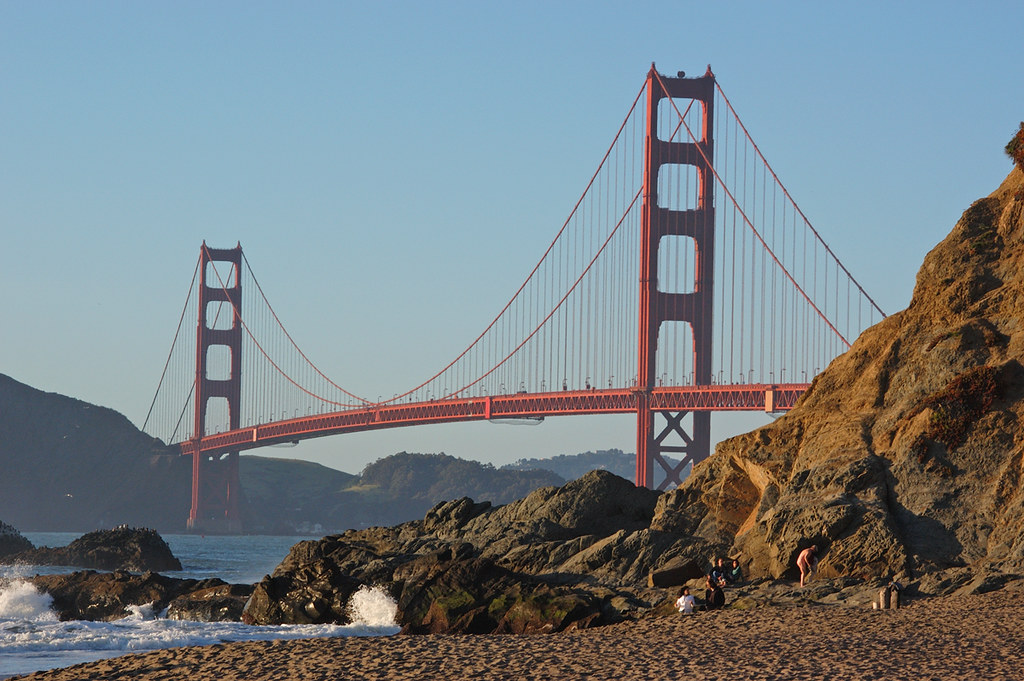

The bridge from Baker Beach, and the sandstone rocks at its north end at sunset.
Baker Beach faces the ocean with the bridge off to the north, so you get the whole span side-on with the Marin Headlands behind it. At the north end of the beach there are sandstone ledges that make the best foreground in the city, especially with a wave washing over them and a half-second exposure.
The bridge is about 17° east of north from here, so the sun never sets behind it; it sets out over the ocean to your left and lights the bridge from the side. That's the light you want. February was the busiest month in our sample, a reminder that the clear days between winter storms are some of the best of the year. June was the quietest.
One practical note: the north end of Baker Beach is clothing-optional. Be thoughtful about where you point a long lens.
- Best light
- The hour before sunset, ideally with a low tide for the rocks
- Busiest months
- February and July (quietest: June)
- Typical shot
- 36mm, f/7, 1/300s, ISO 160
- Getting there
- Parking off Gibson Road; Muni 29 bus to the Presidio
3. Fort Point
Marine Drive, under the south end of the bridge


The bridge at night from the seawall, and its south tower by day.
Fort Point is a brick fort finished in 1861, and when the bridge was built in the 1930s the engineers liked it enough to build an arch over it rather than knock it down. You can stand on the seawall right under the south end, with the deck overhead and waves breaking against the wall. It's where Kim Novak jumped into the bay in Vertigo.
This spot surprised us. 29% of the photos we sampled were taken at more than 200mm, the most of any spot in this guide. Here you're close enough to the south tower that a long lens isolates the rivets and the cables, and from the pier at Torpedo Wharf, a few minutes' walk back toward the city, a long lens squeezes the whole span against the hills.
Like Baker Beach, it's at sea level, so it's the first place the fog swallows. June was its quietest month, August and September its busiest.
- Best light
- Blue hour, when the bridge lights come on
- Busiest months
- August and September (quietest: June)
- Typical shot
- 50mm, f/6.3, 1/320s, ISO 250
- Getting there
- Marine Drive, below the bridge toll plaza; limited parking
4. Lands End and the labyrinth
Lands End Trail, above Mile Rock Beach


The stone labyrinth on its headland, and the rocks below Lands End at sunset.
The Lands End trail follows the cliffs at the city's northwest corner, through cypress trees, with the Golden Gate opening up to the north. Below it, on a small headland above Mile Rock Beach, someone laid out a labyrinth of stones in 2004. It's been vandalized and rebuilt more than once, and on a clear evening, with the sun setting over the ocean beyond it, it's one of the most peaceful places in the city.
Phones rule here. The median aperture in our sample was f/1.8 at ISO 80, the numbers a phone camera reports, and it makes sense: it's a hike, and people travel light. If you do bring a camera, a wide lens and a small tripod are enough. The steps down to the labyrinth are steep, so watch your footing in the dark.
- Best light
- Sunset, on clear evenings in autumn and winter
- Busiest months
- July and October (quietest: April)
- Typical shot
- 29mm, f/1.8, 1/1400s, ISO 80
- Getting there
- Lands End Lookout visitor center, Point Lobos Avenue
5. Sutro Baths
Point Lobos Avenue, below the Cliff House


Sunset over the ocean from the ruins.
In 1896 Adolph Sutro opened the world's largest indoor swimming complex here, with seven pools fed by the tide. It burned down in 1966, and what's left is a set of concrete walls and channels on the edge of the ocean, flooded at high tide, with a tunnel through the rock to the north.
It faces west, straight out to sea, and January was by far its busiest month, with 17% of all the visits we counted. Winter is the clear season on this coast, and in January the sun sets in the southwest, over open water, with nothing between you and the horizon. May, when the wind and the fog roll in, was the quietest month.
The light here is bright, with the sea and the sky in front of you, and people shot fast: the median was around 1/900s at f/2.8. For silhouettes of the walls against the sunset, expose for the sky.
- Best light
- Sunset in winter
- Busiest months
- January and April (quietest: May)
- Typical shot
- 35mm, f/2.8, 1/926s, ISO 100
- Getting there
- Lands End Lookout parking; Muni 38 bus
6. The Painted Ladies
Alamo Square, Steiner Street


The Painted Ladies on Steiner Street, with downtown behind them.
The row of Victorian houses on Steiner Street is probably the most photographed street in San Francisco, and it was the busiest spot in this guide, with 235 visits in our sample. The view is from the slope of Alamo Square, the park across the road, looking east, with the houses in front and the towers of downtown rising behind.
The houses face west toward the park, so they're in shade all morning and lit by the late afternoon sun, which is when to come. The people in our sample stood back and zoomed in: the median focal length was 50mm, and three-quarters of the photos were taken at 35mm or longer, which keeps the houses big and the skyline close. January was the quietest month, October and July the busiest.
- Best light
- Late afternoon to sunset
- Busiest months
- July and October (quietest: January)
- Typical shot
- 50mm, f/5, 1/250s, ISO 250
- Getting there
- Muni 21 bus to Hayes and Steiner
7. Lombard Street
Between Hyde and Leavenworth Streets, Russian Hill


The eight bends of the crooked block, from the top and from the bottom.
The crooked block of Lombard Street drops down Russian Hill in eight hairpin bends between brick paving and flower beds. There are two views: from the top at Hyde Street, looking down the bends to Coit Tower and the bay, and from the bottom at Leavenworth, looking up at the whole thing stacked like a ribbon.
At night, from the bottom, a long exposure turns the cars' brake lights into a red zigzag down the hill. In early summer the hydrangeas in the beds are in flower. 62% of the photos we sampled were taken with a wide lens, and it's the right call from the bottom; from the top, a longer lens picks out the bends against the bay. It's busy from mid-morning, so go early. September was the busiest month here, November the quietest.
- Best light
- Early morning for an empty street; night for light trails
- Busiest months
- May and September (quietest: November)
- Typical shot
- 28mm, f/2.2, 1/800s, ISO 160
- Getting there
- The Powell–Hyde cable car stops at the top
8. The Palace of Fine Arts
Baker Street, the Marina


The rotunda lit up over the lagoon at night, and by day.
Bernard Maybeck designed the Palace for the 1915 Panama-Pacific Exposition as a temporary building, in plaster, and it was so loved that the city rebuilt it in concrete in the 1960s. The rotunda and its colonnades stand at the edge of a lagoon with swans, and on a still morning the whole thing is reflected in the water.
Come at either end of the day. Early morning, the lagoon is calm and the paths are empty except for runners. In the blue hour after sunset the rotunda is floodlit, which is the shot in most of the night photos in our sample. A wide lens gets the reflection in; half the photos were taken between 20mm and 35mm. May was the busiest month, September the quietest.
- Best light
- Still early mornings, or the blue hour
- Busiest months
- May and August (quietest: September)
- Typical shot
- 27mm, f/2.2, 1/180s, ISO 100
- Getting there
- Muni 30 bus to Broderick and Beach
9. The Bay Bridge from the Embarcadero
Rincon Park and the waterfront below Harrison Street


The west span of the Bay Bridge at night and at dusk, from the Embarcadero.
The Golden Gate gets the attention, but the Bay Bridge is the one you can photograph from the middle of the city. Walk south along the Embarcadero from the Ferry Building to Rincon Park, where Claes Oldenburg and Coosje van Bruggen's giant bow and arrow is stuck in the lawn, and the west span of the bridge rises right over the waterfront.
Its cables carry the Bay Lights, an LED artwork that ripples across the span after dark when it's running, and that's the reason to come at night. With a tripod and a few seconds' exposure, the lights and the water both go smooth. In early summer the sun comes up out over the bay to the right of the bridge, so it's a sunrise spot too. July and September were the busiest months here, December the quietest.
- Best light
- Blue hour and night, for the lights
- Busiest months
- July and September (quietest: December)
- Typical shot
- 33mm, f/2.4, 1/200s, ISO 100
- Getting there
- Embarcadero station (BART and Muni), 10 minutes on foot
10. The skyline from Treasure Island
Avenue of the Palms, Treasure Island

Treasure Island was built in the middle of the bay for a world's fair in 1939, and its southwest shore, along the Avenue of the Palms, has the best view of the whole of downtown in one frame. You look back across the water at the skyline, the Bay Bridge coming in from the left and Coit Tower on the right.
Downtown is to the southwest from here, so the sun sets behind it in winter, and here's the bonus: the Golden Gate Bridge, far off on the horizon to the west, is at a bearing of about 277°. The sun sets on that line around April 3 and September 10, so on those evenings it goes down right through the Gate, ten kilometers away. Spring was the busiest season here in our sample, with April on top.
On the way, stop on Yerba Buena Island, where a viewpoint under the bridge frames downtown through its steelwork.
- Best light
- Sunset and blue hour; sunset through the Golden Gate around April 3 and September 10
- Busiest months
- March and April (quietest: February)
- Typical shot
- 29mm, f/2.2, 1/1199s, ISO 54
- Getting there
- Muni 25 bus from the Salesforce Transit Center, or drive across the Bay Bridge
One more, if the fog comes in
If the bridge has vanished, head inland and uphill. Twin Peaks, in the middle of the city, is often above the summer fog, with Market Street running straight down to the Ferry Building and the Bay Bridge. Four of the sixteen photos we sampled there were long exposures, taken after dark, when the city's lights are spread out below like a map.

How we worked it out
For each spot we took up to 500 of the most interesting public Flickr photos taken nearby, counted one visit per photographer per day, and added them up by month. The typical settings are medians from the camera data of twenty of those photos, each by a different photographer. Sun bearings were calculated for each viewpoint and are good to a day or two. Every spot has its own page on ShotHotspot with its photos, a map and the sun and moon tool, so you can check where the sun will be on the day you go, though for the fog you'll still need a forecast and some luck.


